22 guides
BIS/STQC 2026 for Factory Cameras: What Owners Must Do
From 1 Apr 2026 every CCTV camera sold in India needs BIS + STQC ER-01 certification. The dates, the certified-vs-banned brands, and the procurement traps plant owners miss.

Where You May Never Put a Camera in an Indian Factory
Washrooms, changing rooms, locker rooms, creche — where a camera must never go in an Indian factory in 2026, your IT Act 66E and BNS 77 exposure, and where to place cameras instead.

How Long Must a Factory Keep CCTV Footage in India?
No single Indian law sets one CCTV footage retention period for factories. Trigger-by-trigger table, a practical 30/90-day default, and storage cost in Rs.

Cameras in Indian Dairy Plants: Chilling Centres, FSSAI and Milk Adulteration
Dairy plant CCTV in India: what cameras at chilling centres and collection docks prove for FSSAI Schedule 4 audits, and what video can never tell you about milk.

Do I Have to Replace My Factory CCTV in 2026? (India)
Do you have to replace your factory CCTV in 2026? India's rules hit new purchases, tenders and expansion — not your installed cameras. What to check first.

DPDP and Worker CCTV: What Indian Factories Must Do
Worker CCTV is personal data under India's DPDP Act. How far Section 7(i) 'employment use' really stretches, when face-recognition turns footage into biometric data, the INR penalty bands, and the phased 2025-2027 deadline.

The Factories Act, 1948 and CCTV: What Every Owner Should Know
The Factories Act, 1948 mandates no CCTV — but state rules made under it now do (Maharashtra, Oct 2025). What the Act requires, the DPDP collision, and where lenses belong.

The Factory CCTV Compliance Checklist (India, 2026)
A one-page factory CCTV compliance checklist for India in 2026: OSH Central Rules 2026, STQC/BIS certified hardware from 1 April 2026, retention, worker notice, night shifts and sign-off.

Cameras in Food Processing Plants: Hygiene, FSSAI & Buyer Audits (India)
Do food processing plants in India need CCTV? FSSAI Schedule 4 mandates the hygiene, not the camera — here's how camera-AI proves gowning, handwash and zone discipline at FSSAI and buyer audits.

Gujarat Factory Camera Rules: What Owners in Vapi, Morbi and Sanand Need
Gujarat factory CCTV rules explained: women's night-shift conditions, records and inspections under the labour codes — for owners in Vapi, Morbi and Sanand.

Best Hikvision & Dahua Alternatives for Indian Factories (2026)
From 1 Apr 2026 India blocks non-STQC/BIS-certified CCTV. Compare the certified brands — CP Plus, Sparsh, Matrix, Prama — plus the supply crunch, SoC…

The Indian Factory Owner's 2026 Camera Playbook: Shifts, Compliance & ROI
India's 2026 camera rules, read as money moves: unlock women's night shifts, buy STQC-certified cameras right, cut guard cost, and stop theft and downtime.
Is CCTV Mandatory in Indian Factories? The Honest 2026 Answer
Is CCTV mandatory in factories in India? No blanket central law forces installation — but night-shift rules, buyer audits and AEO assessments do. 2026 scenario table.

Women's Night Shift in Maharashtra: The CCTV & Compliance Guide (2026)
Maharashtra Rule 102-B lets you run women's night shifts if you keep CCTV for ~45 days, 2+ women on duty, consent, transport & a female guard. Here's how.

The OSH Code 2020 and Factory CCTV: What Replaced the Factories Act
The Factories Act 1948 was repealed in Nov 2025. What the OSH Code 2020 and Central Rules 2026 mean for factory CCTV in India: thresholds, consent, records.
Which Indian States Require CCTV to Run Women at Night (2026 Tracker)
Yes — most Indian states now require CCTV to run women on night shifts. Dated state-by-state tracker: Maharashtra, Gujarat, Karnataka retention rules.
STQC/BIS-Approved CCTV Cameras in India: The 2026 List, Explained
From 1 Apr 2026 only STQC/BIS-certified CCTV can be sold in India. Why there is no single list, how to verify a specific model, and the chipset gate behind certification.
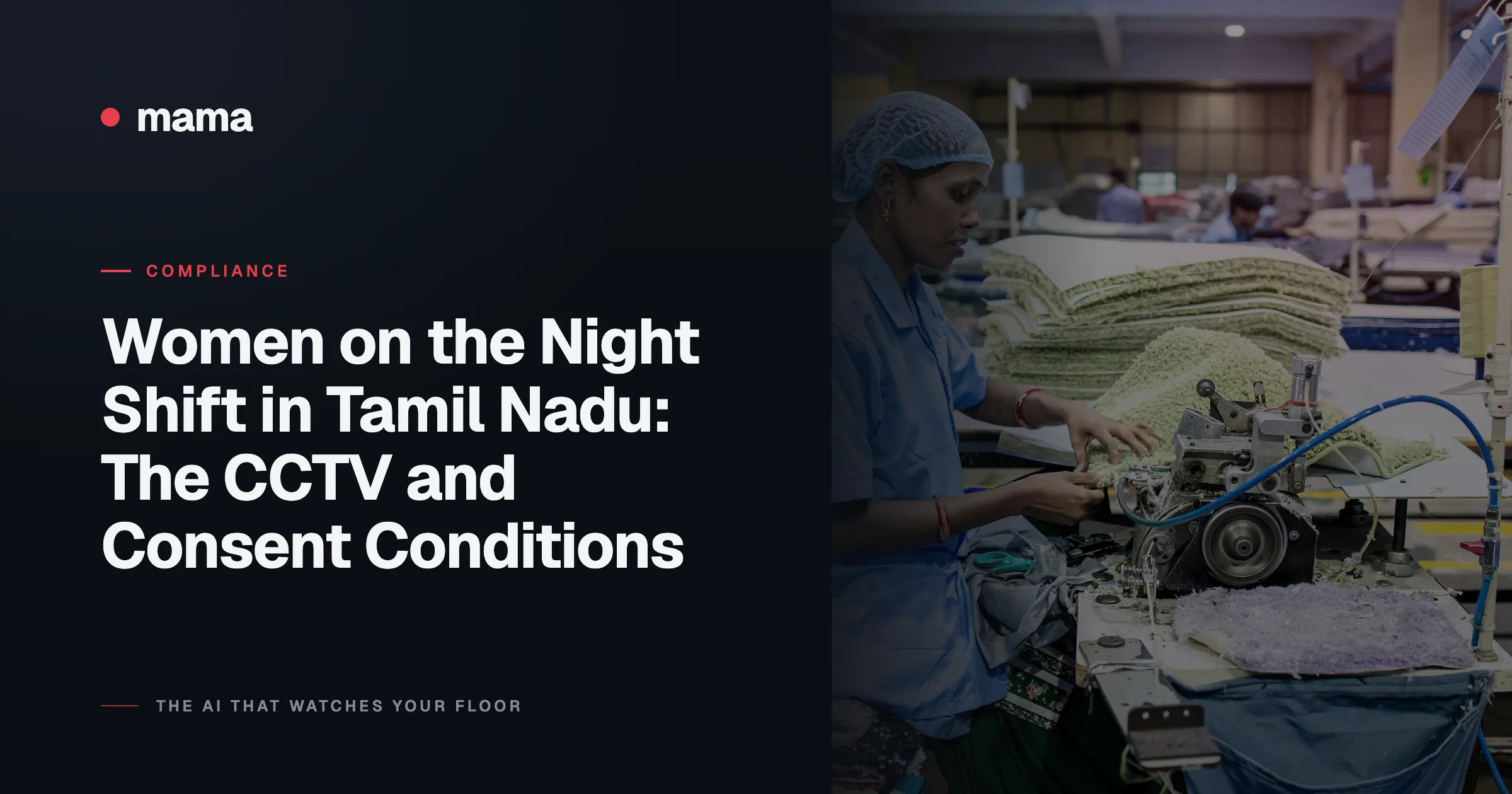
Women on the Night Shift in Tamil Nadu: The CCTV and Consent Conditions
Tamil Nadu women night shift CCTV rules: consent, transport, wardens and the camera coverage a labour officer expects in Tiruppur and Chennai under the OSH Code.

Running a Night Shift in a Textile Unit: CCTV, Compliance & the ₹ Case
Night-shift textile units in India need women's-night-shift CCTV (often ~45-day retention) to add export capacity. What Tirupur & Ludhiana owners need.

Running Women on the Night Shift in India: The CCTV the 2026 Rules Now Expect
Running women on the night shift is extra capacity from the same plant. India's 2026 rules make CCTV a precondition — here is how many cameras, where, and how long to keep footage.
CCTV Records for Women's Night Shifts: The Retention & Audit Checklist (India, 2026)
How many days to keep women's night-shift CCTV footage in India (Maharashtra ~45 days), which registers and consents to hold, and how to make it all retrievable for an inspection.

The Worker CCTV Notice Your Factory Needs Under DPDP (with Template)
A DPDP worker CCTV notice template for Indian factories: what the 2025 Rules expect on signage, purpose, retention and grievance route, in English and Hindi.