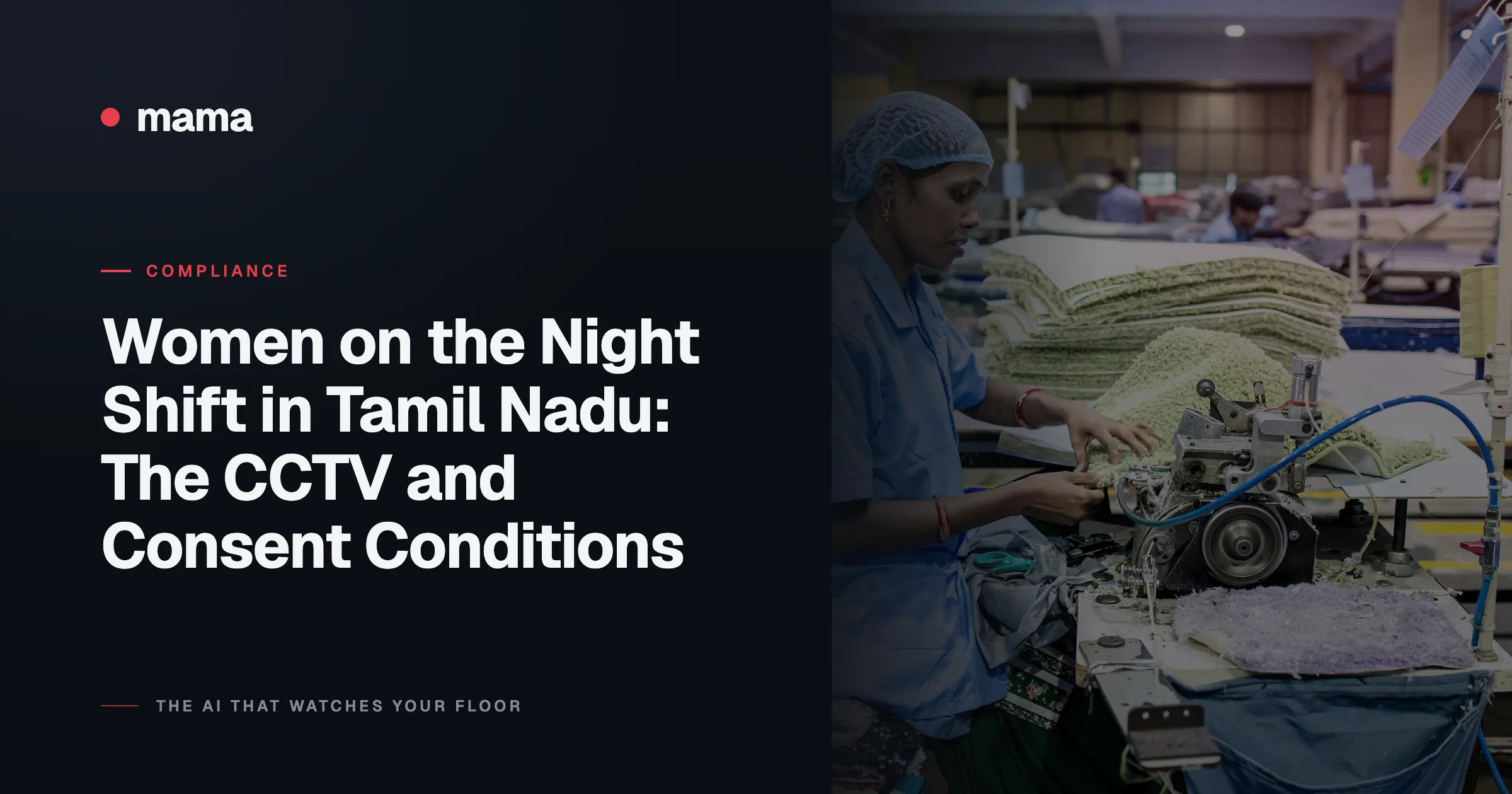
Women on the Night Shift in Tamil Nadu: The CCTV and Consent Conditions
Cameras are part of the package, not a nice-to-have. Section 43 of the OSH Code 2020 lets women work before 6 a.m. and after 7 p.m. with their consent, on conditions that the State government prescribes for a factory. The OSH (Central) Rules 2026, which bind central-sphere establishments, ask for CCTV "on the way to" toilets, washrooms and drinking water. In Tamil Nadu, cameras also prove the consent, transport and supervision conditions were met.
You run 300 to 800 workers in Tiruppur, Ambattur, Sriperumbudur or Hosur. A buyer wants a second shift. Your HR head says "women can't work nights." That has not been true since November 2025 — but the paperwork and the physical arrangements around it are where units get caught. The enforcing officer's questions are not about the machines. They are about the gate, the bus, the warden and whether you can show him what happened at 2 a.m. last Tuesday.
Key points
- The Factories Act 1948 is gone. It was repealed on 21 November 2025 along with 12 other central labour laws when the Occupational Safety, Health and Working Conditions Code, 2020 was brought into force. Any consultant still quoting "Section 66" is working from a repealed statute.
- Consent is the statutory hinge. Section 43 entitles women to employment in all establishments and permits work outside 6 a.m.–7 p.m. "with their consent", subject to conditions on safety, holidays and hours. No consent record, no defence.
- CCTV is in the national template, on a narrow scope. Rule 83 of the OSH (Central) Rules, 2026 (G.S.R. 345(E), 8 May 2026) lists written consent, pick-up and drop transport, a well-lit workplace and passages, toilets and drinking water nearby with "closed-circuit television surveillance on the way to these facilities", displayed emergency numbers and POSH compliance (Gazette of India). The Rules prescribe no camera count, resolution or retention figure, and they bind central-sphere establishments, not a private Tamil Nadu factory, which follows the state's rules.
- Tamil Nadu is actively rewriting its rules. The state notified draft amendments to the Tamil Nadu Factories Rules, 1950 on 1 October 2025, opening 20 previously restricted "dangerous" operations to women and putting night work on a consensual basis — with a proposed floor that at least 10 workers or one-third of the night-shift staff be women, whichever is greater. Trade unions including CITU objected that the draft addresses inclusion without enforcement of safety.
- That floor reshapes your roster before it reshapes your cameras. A 60-person night shift with four women fails the draft ratio; you either add women or you do not run women that night.
- Cameras are evidence, not permission. A ₹3.5–6 lakh build across gate, transport bay, canteen, corridors and shop floor is cheap next to one contested night incident — but it satisfies one condition out of six. It mostly lets you answer questions.
- Cameras also create liability. Footage of a woman worker is personal data under the DPDP Act 2023, where the ceiling for failing to take reasonable security safeguards is up to ₹250 crore. Recording where you should not is worse than not recording.
What actually changed on 21 November 2025
For over seventy years the rule was simple and restrictive: under Section 66 of the Factories Act 1948, women could not work in a factory between 7 p.m. and 6 a.m. unless the state government exempted the unit. Tamil Nadu granted such exemptions, industry by industry, with long condition lists attached.
The OSH Code inverts the default. Women are entitled to all work in all establishments; night work is available with consent and prescribed safeguards. The Code also raised the factory threshold to 20 workers with power or 40 without, roughly doubling the old numbers, subject to a proviso preserving a different number already fixed by state law.
Three practical consequences for a mid-size Tamil Nadu unit:
- You are no longer asking permission for the concept. You are demonstrating conditions.
- In the national template, one condition is literally a camera, on a narrow scope: rule 83(d) of the Central Rules asks for CCTV "on the way to" toilets, washrooms and drinking water, and says nothing more about it.
- The detail lives in state rules, and Tamil Nadu's are in motion. As of early 2026 Tamil Nadu had finalised rules only under the Code on Wages, so your file has to satisfy the enforcing officer of the Directorate of Industrial Safety and Health, not a generic national checklist. Read our OSH Code 2020 and factory CCTV note alongside this one.
The five things an enforcing officer asks to see
He does not start with the camera. He starts with the register, then asks the camera to corroborate it.
| What he asks for | The document | What the camera has to show |
|---|---|---|
| "Did she agree?" | Signed, dated consent — per worker, revocable, in Tamil | Nothing. Cameras cannot prove consent. Do not try. |
| "How did she get home?" | Transport log: vehicle no., driver, route, drop times | Transport bay: faces boarding, timestamp, vehicle plate |
| "Who supervised?" | Warden / women-supervisor roster for each night shift | Shop floor and corridor coverage during the shift |
| "Is the plant lit and manned?" | Lux readings, security deployment, helpline display | Gate, corridor, canteen, stairwell — usable at night |
| "Show me the night of the 14th" | — | Retrievable footage on demand, not "the DVR overwrote it" |
That last row is where most units fail. Not on policy — on retrieval. A ₹40,000 NVR that keeps 12 days and needs the IT boy to export is a compliance failure disguised as an IT problem. Fix the retention question first: see CCTV footage retention periods for Indian factories.
Consent is a record, not a conversation
Get this wrong and nothing else matters.
- Individual, not collective. A union agreement or a notice-board circular is not consent. One signed form per woman; the Central Rules put the requirement in writing.
- In Tamil. A migrant worker from Odisha or Jharkhand in a Tiruppur unit signing an English form is a document an officer will discount in ninety seconds.
- Revocable, and seen to be revocable. Keep a withdrawal column in the same register. If nobody has ever withdrawn in three years, that register looks manufactured.
- Dated before the first night worked. Backdating is the finding that ends the conversation.
- Separate from the DPDP camera notice. Consent to work nights and notice about being recorded are two different instruments. Bundle them and you weaken both. Template logic in our worker CCTV privacy notice under DPDP.
The camera coverage that matches the conditions
The obligations are about movement between the gate and the machine at night, not about the machine. So the coverage plan for a night shift differs from your day-shift theft plan.
Priority order for a typical 400-worker Tiruppur knitting or garmenting unit:
- Transport bay / bus boarding point. The single highest-value camera. Proves the drop happened, at what time, with whom. Get plate readability, not just a wide shot.
- Main gate, both directions. Entry and exit timestamps that reconcile with the attendance system.
- Corridors to the washroom block and canteen. Not inside — the approach. This is where night-shift incidents are alleged.
- Stairwells and unlit external paths. Lighting first, camera second; a camera on a dark path records a dark path.
- Shop floor, wide. One or two per bay to establish presence and supervision — not to count stitches.
Two hard technical points. Ordinary cameras at 2 a.m. in a shed lit to walkway levels produce unusable grey mush; you want low-light-capable sensors on the approach routes or you have bought an alibi you cannot play. And nights are exactly when nobody is watching the monitor — which is the case for automated review rather than more screens. Placement detail in where to place cameras on the shop floor.
Indicative rupee budget, our own build estimates for Tamil Nadu units, not a legal requirement:
| Item | Typical range |
|---|---|
| 20–28 cameras, low-light on approach routes | ₹1.8–3.2 lakh |
| PoE switches, cabling, UPS, labour | ₹80,000–1.5 lakh |
| NVR/storage sized for 45–90 days of retention | ₹60,000–1.2 lakh |
| Extra lighting on transport bay and paths | ₹40,000–1 lakh |
Call it ₹3.5–6 lakh for a plant running one women's night shift, against the revenue of a second shift on a buyer's order. The lighting line is the one owners cut and the one that decides whether the rest works.
Where cameras do not help — and where they hurt you
This is the section vendors leave out.
Cameras do not create permission. The camera line is one condition among consent, transport, lighting, sanitation and helpline display. A unit with 60 cameras and no consent register is more exposed than one with six cameras and a clean register — because the footage is now discoverable.
No statute gives you a camera spec. Neither the Code nor the Central Rules prescribe resolution, camera count, frame rate or a national retention figure. Anyone quoting you a statutory camera specification is quoting a state condition, a buyer's tender term or their own product sheet.
Cameras cannot go where the risk feels highest. Washrooms, changing rooms, feeding rooms, the inside of rest rooms — never, under any framework, for any reason, no matter who asks. A single camera in a changing room converts a safety programme into a criminal matter. See CCTV banned areas in Indian factories.
Cameras can undermine a POSH inquiry. Every workplace with 10 or more employees must have an Internal Committee under the POSH Act 2013, and the inquiry is confidential, with a penalty for breaching that confidentiality. If your security supervisor pulls footage of a complainant and circulates it in a WhatsApp group "for the investigation", you have handed her a second, stronger case. Footage requests during a POSH matter route through the IC alone, in writing.
Cameras generate a data obligation. Under the DPDP regime, worker footage is personal data. The DPDP Rules, 2025 were published on 13 November 2025, and the Data Protection Board was set up the same day. G.S.R. 843(E) of 13 Nov 2025 brings Sections 3 to 17 of the DPDP Act into force on 14 May 2027, and the substantive duties (notice, purpose limitation, retention and erasure, breach reporting) apply from that date. Unlimited retention, an open NVR password and export by anyone with a pen drive are defects you have time to fix now and none to fix later.
Cameras will not fix a shift nobody wants to work. If women are not volunteering, the reason is usually the bus route, the drop-point distance or the warden — not the absence of monitoring. Surveillance answers "what happened"; it never answers "why won't they sign".
A 10-day plan before your first women's night shift
- Day 1–2. Draft the consent form in Tamil. Have your IC chair, not your labour consultant, read it aloud to five workers and tell you what they misunderstood.
- Day 3. Fix the warden roster: named women supervisors, one per shift, with a phone that is answered. Put helpline numbers on the plant notice board and inside the vehicles.
- Day 4–5. Walk the plant at 1 a.m. with a lux meter. Every dark metre between gate, floor, canteen and washroom block gets lighting before it gets a camera.
- Day 6–8. Install or re-aim cameras on transport bay, gate, corridors, stairwells. Test night footage — actually play it back at 2 a.m. and try to identify a face.
- Day 9. Set retention and access: who can export, logged, with a written request trail.
- Day 10. Run one dry night shift with a skeleton crew. Then ask your DISH officer to look at it before you scale. Officers are far more helpful before a shift runs than after an incident.
Cross-check against the women's night shift CCTV and retention checklist.
FAQ
Is CCTV legally mandatory for women's night shifts in Tamil Nadu? On a narrow scope in the national template. Rule 83(d) of the OSH (Central) Rules 2026 asks for CCTV "on the way to" toilets, washrooms and drinking water where women work outside 6 a.m.–7 p.m., alongside consent, transport, lighting and helplines. It is not a general factory camera mandate and carries no spec. The Central Rules bind central-sphere establishments; for a private Tamil Nadu factory the State sets the conditions (OSH Code s.2(1)(d)), so ask DISH which conditions apply to your unit.
How long should I keep night-shift footage? There is no national number. Karnataka's night-shift conditions named at least 45 days, and so does Maharashtra's amended Rule 102-B. Ninety days is a commercial choice for gate and transport cameras, not a statutory one, and under DPDP you should not keep footage longer than the stated purpose needs.
Can I record the women's rest room area for their own safety? No. Never inside rest rooms, washrooms, changing rooms or feeding rooms — regardless of intent, worker agreement or buyer request. Cover the approach corridor outside instead. A camera inside those spaces is indefensible and creates criminal and DPDP exposure at once.
Does the one-third women requirement apply to my unit today? It is a proposal in Tamil Nadu's draft rule amendments notified on 1 October 2025: at least 10 workers or one-third of night-shift staff being women, whichever is greater. A draft binds no one until it is notified as a final rule, and unions objected to this one. Design the shift so the ratio is met either way, and ask your DISH officer which conditions apply before rostering.
Can footage be used to discipline a worker on the night shift? Yes, if the purpose was disclosed in your privacy notice and the process is fair. But if the matter touches harassment, route it through the Internal Committee only. Using surveillance to punish a complainant, or circulating her footage internally, is the fastest route from a manageable complaint to a legal one.
My buyer's social audit asks for camera coverage. Is that the same standard? No. Buyer audits (SEDEX, brand codes of conduct) frequently ask for evidence of safe transport and supervision, which cameras support. They also penalise surveillance that intrudes on privacy. The two standards converge on the same design: cover movement and access points, never private spaces.