Supervisor, Register, Biometric or Camera: Who Tells You the Truth About Your Shift?
Who tells the truth about your shift: supervisor, register, biometric or camera? As of 17 Oct 2026, none alone. Under the Model Standing Orders, 2026 (S.O. 2312(E), 8 May 2026), attendance is registered twice a shift, at its start and close, so the biometric proves presence at the gate, not work at the line. Trust each source only for its own question.
By the Mama Editorial Team. Last checked: 17 Oct 2026. Not legal advice.
Key takeaways
- Each of the four sources answers a different question. The register and biometric answer "who should be paid", the camera answers "how many people were at the line at 10:30", and only the supervisor can answer "why did it stop".
- Every source can be bent, and each by a different person. The supervisor writes the report he is judged on. The timekeeper fills the register. Whoever keys in "manual punches" edits the biometric. Whoever sets up the camera decides where its count zones are.
- For an assumed 400-worker plant in Noida, running all four costs roughly ₹87,000 to ₹1.07 lakh a month. If all 400 were paid an assumed ₹580 a day, 1% of the wage bill would be about ₹60,000 a month.
- The useful habit is one daily check of three numbers that should agree: register headcount, biometric count and the on-line count. Investigate the gap. Don't punish it automatically.
- Cameras give counts, not names and not intent. Keep them at the aggregate, and give workers a written notice under the DPDP Act.
The four witnesses, and what each one actually saw
The supervisor was on the floor. He knows that Line 3 stopped because the bundle did not come, that two helpers were sent to the stores, and that the new operator on machine 14 needed an hour of help. He alone can explain why, and the shift report judges him.
The muster register is the statutory record. Under the OSH&WC (Central) Rules, 2026, rule 72 lists an "attendance register-cum-muster roll in FORM XIV" and says registers "shall be maintained electronically or otherwise" (G.S.R. 345(E), e-Gazette, 8 May 2026). The Central Rules bind central-sphere establishments; a private factory follows its state's rules. Either way, the register is only as good as the person filling it.
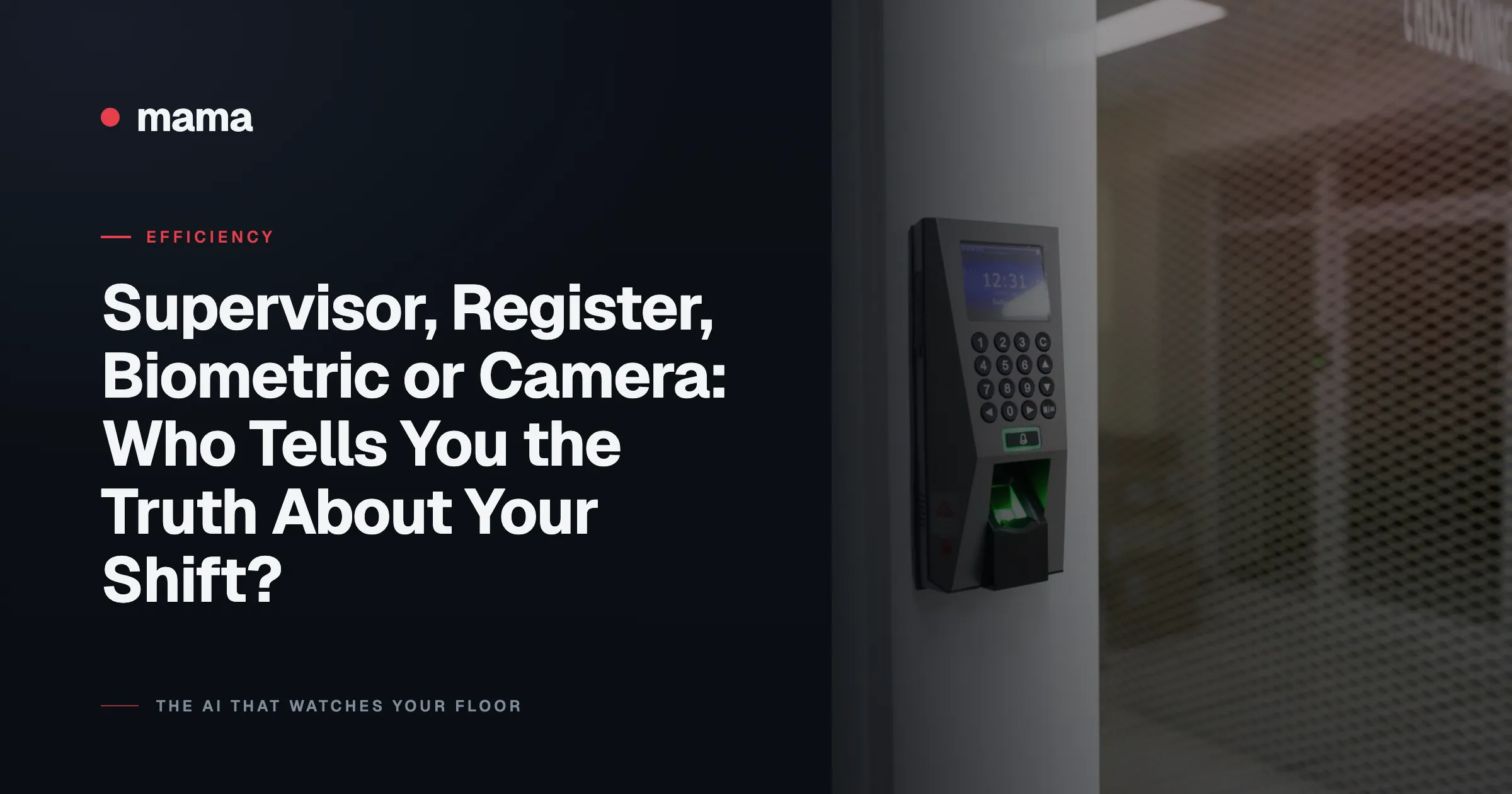
The biometric terminal stands at the gate. Under the Model Standing Orders, 2026, Schedule B para 9 (S.O. 2312(E), e-Gazette, 8 May 2026), it records two moments per person per day: arrival and departure. What that gap costs in paid hours is the subject of the biometric vs machine hours page; here the question is who can edit those two moments, and who can see the hours in between.
The camera sees the floor between those two moments. It can count how many people stood in a station zone at 10:30, and whether a machine was moving. It cannot tell you who they were (if set up properly) or why a station was empty.
Source by source: captures, limits, who can bias it, ₹ a month
Assume a 400-worker plant in Gautam Buddha Nagar (Noida), one general shift, 10 line supervisors, 4 gate terminals and 12 existing cameras looking at line entries and station zones. Every ₹ figure below is either sourced in the same row or labelled as an assumption.
| Source | What it captures | Accuracy limits | Who can bias it | Running cost (₹/month, assumed 400-worker plant) |
|---|---|---|---|---|
| Supervisor's word and shift report | Reasons for stops, who was moved where, quality issues, judgement | Written late and from memory; short stops and waiting rarely make it in; one supervisor cannot watch 40 people at once | The supervisor, who is judged on the same numbers | ≈ ₹53,170: 10 supervisors × ₹26,585 a month (Payscale average of ₹3,19,022 a year, self-reported, 176 profiles, updated 4 Apr 2026) × assume 20% of their time on attendance, registers and reports |
| Muster register (Form XIV-type) | Who was present or absent, shift, section, in and out times | The in and out times are only as good as whoever writes them, often later; says nothing about time at the line | Timekeeper, contractor's supervisor, anyone who can add a name for an absent worker | ≈ ₹16,900: assume one timekeeper at ₹650 a day × 26 days (illustrative; take the current notification from the UP Labour Department) |
| Biometric at the gate | Arrival and departure time per person | Gate is not the line; failed reads end up as manual entries; cannot see breaks, waiting or wash-up inside the shift | Whoever has the admin login to key "manual punches" or edit a record | ≈ ₹3,100: assume 4 terminals at ₹10,000 each over 36 months (₹1,111) + assume ₹2,000 software and maintenance; 35 priced IndiaMART listings ran from ₹2,300 to ₹1,05,000 per terminal, median ₹9,000 (checked 17 Oct 2026) |
| Camera counts on the floor | People per zone over time, station manned or empty, machine moving or still | No names, no intent, no reasons; blind behind racks and in dense benches; one camera angle per zone | Whoever sets the count zones and camera angles; anyone who blocks a lens with a stacked pallet | ≈ ₹13,700–34,200: assume 12 existing cameras × ₹1,000–2,500 analytics licence + one edge box of ₹60,000–1,50,000 over 36 months (our planning bands from the retrofit cost breakdown, not a quote) |
Added up, the assumed plant spends about ₹87,000 to ₹1.07 lakh a month on knowing what happened in its shift, most of it supervisor time.
Now compare it with the size of the thing being measured. Assume all 400 workers are paid ₹580 a day, or ₹15,080 a month (illustrative; each state notifies its own minimum wages by trade and skill, so use your current notification). The wage bill is then ₹60,32,000 a month before employer PF and ESI. One percent of that is about ₹60,320 a month. A source that is wrong by even 1% in the direction nobody checks costs more than the camera line at its upper estimate, and about three times the register and biometric combined.
Which question goes to which witness
The common mistake is asking one source every question.
| Question the owner asks | Best source | Second source to cross-check | Source that cannot answer it |
|---|---|---|---|
| Who should be paid for today? | Register / biometric | Contractor's bill | Camera (no names, by design) |
| How many people were at the lines at 10:30? | Camera counts | Supervisor's round | Biometric (gate only) |
| How long did the floor take to start after the bell? | Camera counts | Supervisor | Register |
| Why did Line 3 stand for 50 minutes? | Supervisor | Maintenance log | Camera (sees the stop, not the cause) |
| How many pieces came off the line? | Counter or packing count | Camera at a fixed count point | Biometric, register |
| Was the contractor's billed headcount on the floor? | Camera counts vs register | Gate biometric | Supervisor's estimate |
For the piece count, the trade-offs are covered in manual vs automated production counting. For machine hours rather than people hours, see the four ways to monitor machine utilisation.
How each witness gets bent, without anyone lying
Most distortion in shift data is not fraud. It is the normal result of who writes what, and when.
The supervisor's report drifts optimistic. Every stop he records is a stop on his record, so a ten-minute wait for material becomes "no issue". The daily shift report problem is structural, not personal: the author is also the subject.
The register drifts toward "full". A name is written in the morning for a worker who arrived at 11. A contract worker who left at lunch stays present for the day. Form XIV does have a column for in and out timings, but on a paper register the out time is often written at day end, as the shift's closing time.
The biometric drifts through overrides. Fingers with cuts, burns, cement or oil fail to read. The queue at the gate grows at 8:58, and the timekeeper is told to "mark them manually". Para 9(5) of the Model Standing Orders says "no worker shall use or punch the Identity Card other than his own" (S.O. 2312(E)). The rule covers the worker. It says nothing about the admin screen, which is where the edits happen.
The camera drifts through set-up. Count zones drawn too wide count a passer-by as an operator. A camera nudged during cleaning stops seeing half a line. A stacked pallet blocks the packing bay for a week.
The daily three-number check
Start with three numbers per section each morning:
- Register headcount for the shift.
- Biometric count of people who punched in.
- Peak on-line count between, say, 10:00 and 12:00, from cameras or from a supervisor's timed round.
If register and biometric disagree, the paperwork has a problem. If biometric and on-line count disagree by more than your normal number of floaters, helpers and stores runners, the floor has a problem. Ask the supervisor which one it is. His answer is the fourth source, and now it has something to be checked against.
Record the three numbers for four weeks without acting on them. That gap is your baseline; a gap that changes is worth a question. Once you know the gap, the biometric vs machine hours page above shows how to put a ₹ value on it.
Two limits keep this check fair. Under the Code on Wages, 2019, s.20, a deduction for absence must be in proportion to the time absent, and total deductions in a wage period cannot exceed 50% of wages under s.18 (Code on Wages, e-Gazette). So the three-number check is a reason to ask questions, never an input that docks anyone's pay.
What cameras cannot tell you about a shift
A camera count is a witness like the others, not the referee.
- No names. A properly set-up count does not identify anyone. That is a design choice, not a gap: for payroll, the register and biometric stay the legal record.
- No intent. Someone standing still may be waiting for material, checking a part or resting; the camera sees the same picture.
- No reasons. The camera sees that Line 3 stopped at 11:05 and restarted at 11:55. Why it stopped is still a question for the supervisor.
- No view where it cannot see. Dense sewing benches, dark dyeing sections, areas behind racking and anything inside an enclosure give soft counts or none.
- Personal data. Footage of recognisable workers is personal data under s.2(t) of the DPDP Act, 2023. Tell workers in writing what is recorded and why, before any counting starts; see the worker CCTV notice under DPDP.
Nothing in the OSH&WC (Central) Rules, 2026 or the Model Standing Orders, 2026 requires camera-based attendance or headcount (both texts checked 17 Oct 2026). The cameras are an operational choice, not a statutory record.
Where Mama fits
Mama reads the cameras a factory already has and, every morning, sends the owner a short plain-language note on where hours leaked the day before: lines that started late, stations that stood empty, machines that sat still. It counts people as aggregates per zone and identifies no one, so it sits beside the register and biometric rather than replacing them, and it does not replace the supervisor's explanation of why. More at askthemama.com. To see what your cameras could cover, leave an email or phone in the form below.
FAQ
Is biometric attendance proof that a worker was working? No. Under the Model Standing Orders, 2026, para 9(3), attendance is registered at the start and close of the shift. A biometric punch proves arrival and departure at the gate. It records nothing about time at the station in between.
Can I replace the muster register with a biometric system? The Model Standing Orders, 2026 allow attendance "by means of identity card, biometrics or any other system" notified for the purpose. Rule 72 of the OSH&WC (Central) Rules, 2026 allows registers to be kept electronically. A private factory follows its own state's rules, so confirm the format your state accepts.
Can I deduct wages based on camera headcounts? A camera count does not identify anyone, so it cannot show that a specific worker was absent. The Code on Wages, 2019, s.20, also requires absence deductions to be proportional to time absent. Use counts to ask questions, and keep pay decisions on the statutory records.
How much does a supervisor cost per month in India? Payscale's self-reported survey gives an average Production Supervisor base salary of ₹3,19,022 a year, about ₹26,585 a month (176 profiles, updated 4 Apr 2026). Pay varies widely by city, industry and experience, so use your own payroll for any calculation.
Which source should I trust when they disagree? Trust each source only for its own question. Use the register for pay and the camera for how many were on the floor. Ask the supervisor why. A gap between them is information, and the first step is to find which source moved.